But what does it all mean? How much will it impact South African investors?
In short, we just don’t know yet. Much of the detail on Trump’s economic policies will only emerge in the months to come.
For now, it is useful to zoom out and gain perspective at a macro level. We can do this by looking back at a wide slice of the past in an effort to decipher insights about the present and the future.
Specifically, let’s examine prior presidencies, including the first Trump presidency, to gauge the ways in which a US administration impacts markets – and the ways in which it doesn’t.
The Trump bump
It’s worth recalling the “Trump bump” for the S&P 500 in the weeks immediately after his election victory on 5 November 2024. Broadly, investors looked happy. US shares had a good month despite a brief pullback likely caused by hints that the Federal Reserve wouldn’t be cutting rates as aggressively as expected.
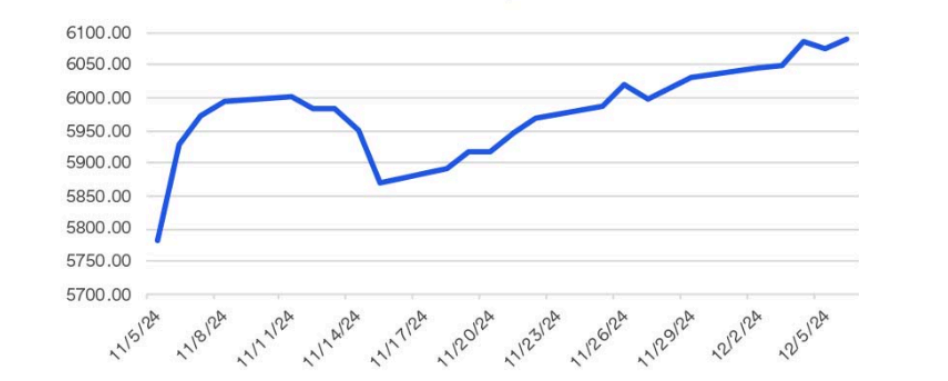
Source: US Bank Asset Management Group
That said, 1nvest products are designed to stay the course. Our clients tend to invest for the long term. So, what does the past tell us about the impact of a US president on markets?
From Trump 1.0 to Trump 2.0
Mark Twain is reputed to have said, “History doesn’t repeat itself, but it often rhymes”. Indeed, we know that the past is not a predictor of the future. But we can learn things from the past that help us prepare for the future. While we don’t expect the policies and outcomes of Trump’s first spell in office to exactly mimic those of his second, the two might just “rhyme”.
Over his first four-year term, the S&P 500 was up more than 50% despite the striking fall in value late in his presidency, when Covid lockdowns caused havoc in markets around the world.
Of course, conditions, policies and Trump’s inner circle will be different this time round. What if we zoom out even further and look at the impact different presidencies have had on markets?
Presidential power
Charting S&P 500 returns for each president since Ronald Reagan took office in 1981 provides a handy overview. All administrations apart from the sequential terms of George W Bush Jr were positive for the index. The younger Bush, however, inherited the aftermath of the dot.com crash, presided over the attacks of 9/11, ensuing wars, and the 2008 financial crisis.
In all, nine out of these 11 presidencies saw moderate to strong growth by the S&P 500, even though they had vastly different economic policies. Trump’s first administration, although marked with controversy, produced returns that align with those of other presidents who had positive economic records.
Find out more about our 1nvest S&P500 Index Feeder ETF, which achieved a total return of more than 150% over five years.
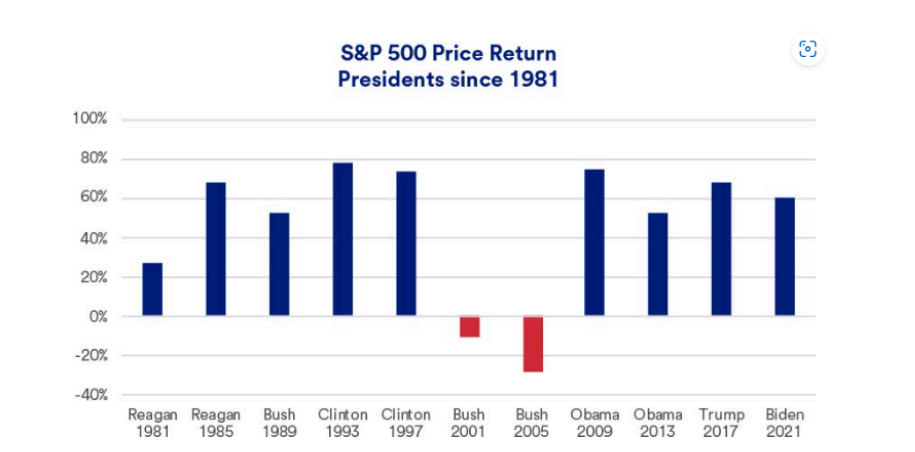
Source: US Bank Management Group. Based on S&P500 prices for the four-year period from inauguration day. For Joe Biden’s term (Biden 2021), returns are to 6 December 2024.
How should we interpret this? This chart is a reminder that much of the hype, speculation and technicalities around US presidents and their power to influence the stock market is exaggerated. As Phil Rosen wrote: “A president may like to take credit for a raging-bull market, but they are just as likely to shirk blame when equities underperform”.
That is not to suggest an individual president is unimportant. It is simply a reminder that sound investment strategies take into account a multitude of forces and that we should avoid getting caught in the emotions that come with a new incumbent in the Oval Office.
Collective Investment Schemes (CIS) are generally medium- to long-term investments. The value of participatory interests may go down as well as up. Past performance is not necessarily a guide to future performance. CIS are traded at ruling prices and can engage in borrowing and scrip lending. A schedule of fees and maximum commissions is available on request from the manager. The manager does not provide any guarantee with respect to the capital or the return of a CIS portfolio. These portfolios are third-party-named incubator portfolios. The manager retains full legal responsibility for these portfolios.
1nvest Fund Managers (Pty) Ltd is an authorised financial services provider (FSP), FSP No. 49955, under the Financial Advisory and Intermediary Services Act (FAIS), Act No. 37 of 2002. The manager of the Schemes is STANLIB Collective Investments (RF) Pty Ltd and registered in terms of CISCA. For the basis and information on awards and rankings, please contact [email protected].