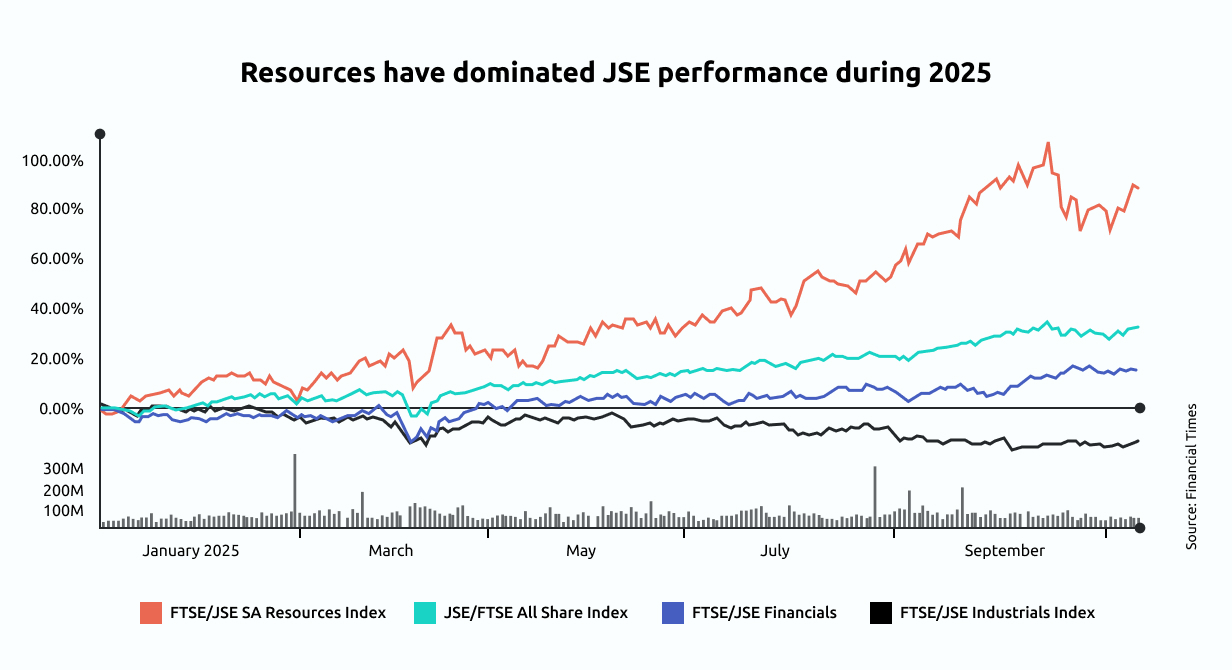
By the middle of November 2025, the Johannesburg Stock Exchange (JSE) All Share Index was up more than 34% for the year to date. That compares to a little over 16% for the S&P 500 and around 21% for the Nasdaq Composite Index.
Very well. The interesting question to ask is why. Although the forces that drive share prices are never entirely clear, we can point to some of the tail winds that played their part.
Gorgeous gold and performing platinum
First and foremost, commodities have been heroes. Gold soared, having started the year at US$2631 per ounce, it broke the US$4000 mark in early October. The 1nvest Gold ETF followed suit, returning 44.53% YTD.
Platinum sparkled even brighter. The metal started 2025 at just over US$900 per ounce. By mid-November, you’d have to spend US$1615 for that same ounce. Our 1nvest Platinum ETF is up more than 57% YTD.
Local producers of gold and platinum have also benefitted – not to mention holders of the locally listed 1nvest Gold ETF and 1nvest Platinum ETF. While South Africa may no longer be the globe’s dominant gold producer – now just about in the top ten – we’ve calculated that the proportion of the world’s platinum supply that is controlled by South Africa, be it directly or indirectly, tops the 90% mark.
Source: Financial Times
The Naspers effect
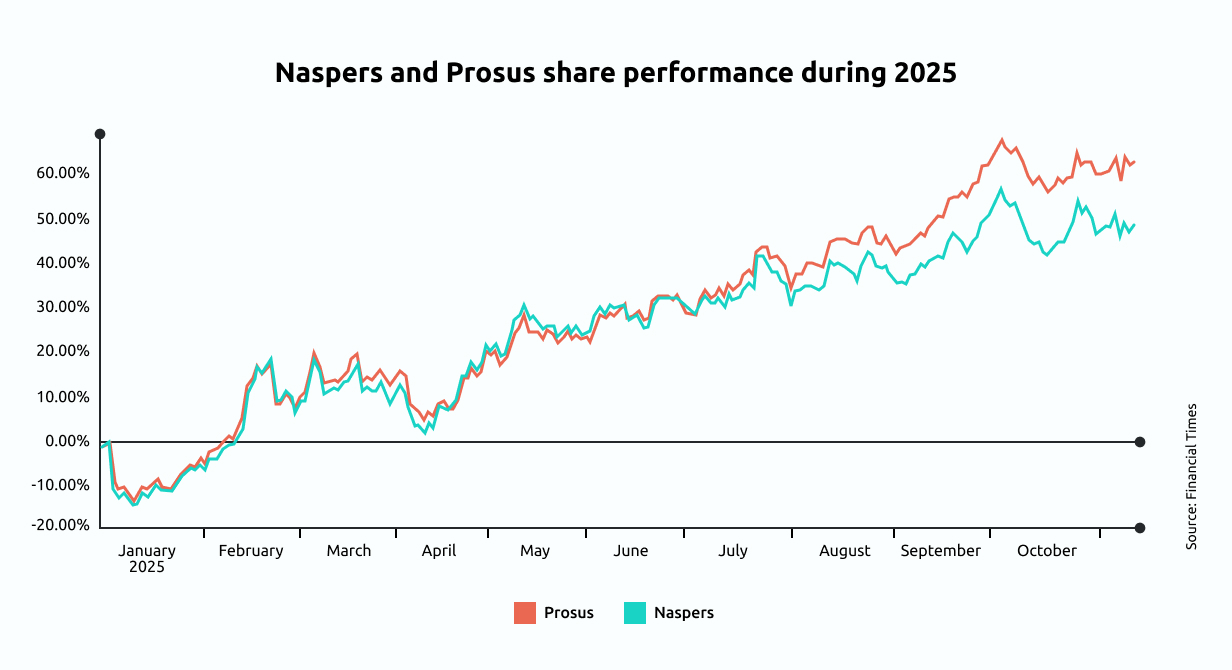
Another outperformer has been Naspers. The media multinational and owner of local favourite brands such as Media24 makes the bulk of its money offshore, chiefly through its stake in Chinese tech business Tencent. A series of complex share splits in the JSE during 2025, involving Naspers and its Dutch- and-Johannesburg-listed subsidiary, Prosus, was instrumental in driving significant growth for both shares through its Tencent exposure. Given that Naspers and Prosus together make up roughly 12.3% of the JSE, this helped pull the entire bourse upwards.
Source: Financial Times
From grey skies to green lights
Despite the fact that overall economic growth has not followed share prices upward, progress with macroeconomic fundamentals has likely contributed to the JSE’s performance. As the South African Reserve Bank said in its June 2025 Financial Stability Review regarding 2024, “factors such as reduced electricity shortages, evidence of fiscal consolidation and an improved sovereign credit rating outlook… bolstered sentiment.”
An honourable mention goes to the momentous project to have South Africa removed from the financial “grey list”. In February of 2023, the Paris-based Financial Action Task Force (FATF) included the country on their list of “Jurisdictions under Increased Monitoring”, based on poor controls around illicit financial flows. Local authorities came together to address all 22 red flags raised, and on 24 October 2025, the nation emerged from this unenviable list. The move should help to sustain positive sentiment.
This speaks to an important distinction. The economy is not the stock market. South Africa’s GDP growth may be teetering on zero, but far more important for shareholders are indicators like corporate earnings. And these are a healthy distance from zero. Analysts expect earnings growth of 20% for 2025 and 15% for 2026.
Local and lucky
In summary, local has been lekker in 2025. Some of that was hard-earned. Listed businesses performed, and public finance bodies came to the party. Local shares got lucky, too. The rising commodities cycle is a global phenomenon that no single country controls. And the Naspers/Prosus surge was a once-off shot in the arm.
Of course, getting lucky isn’t a strategy. As investors, we certainly take good fortune when it comes around. The key is being in a position to benefit when it does. Our commodity ETFs and range of other index-linked investment products are designed to let you do just that. Holders of the 1nvest Top 40 ETF, for example, participated in 2025’s riches from multiple angles – from Naspers (this product’s largest holding at 13.93%) and Prosus to major miners like Gold Fields and AngloGold Ashanti.
As much as 2025 has been a banner year for local equities, this reinforces not the short window of a good year, but the power of patience. It serves as a reminder of the benefits of time in the market, a robust portfolio that matches your goals, and straightforward investment products that make it all possible.
Collective Investment Schemes (CIS) are generally medium- to long-term investments. The value of participatory interests may go down as well as up. Past performance is not necessarily a guide to future performance. CIS are traded at ruling prices and can engage in borrowing and scrip lending. A schedule of fees and maximum commissions is available on request from the manager. The manager does not provide any guarantee with respect to the capital or the return of a CIS portfolio. These portfolios are third-party-named incubator portfolios. The manager retains full legal responsibility for these portfolios.
1nvest Fund Managers (Pty) Ltd is an authorised financial services provider (FSP), FSP No. 49955, under the Financial Advisory and Intermediary Services Act (FAIS), Act No. 37 of 2002. The manager of the Schemes is STANLIB Collective Investments (RF) Pty Ltd and registered in terms of CISCA. For the basis and information on awards and rankings, please contact [email protected].