So, what do you own when you invest in one of our 1nvest exchange traded funds (ETFs) or unit trusts?
Owning ETFs
Our ETFs are legally regulated products that are listed on the Johannesburg Stock Exchange (JSE). When you, the investor, buy into the ETF, you don’t actually own the equities or bonds that make up the ETF. Rather, you gain proportional exposure to those assets by owning a share of the ETF.
Why does that matter? As fund managers, we ensure that each ETF holds the stipulated assets in the right proportions. This mix is determined by the particular index each ETF is built to track. For example, it may be the most valuable shares in South Africa, US government bonds, or a blend of equities and bonds from a certain region.
Then we rebalance the fund at set intervals to ensure we continue tracking the relevant index of assets. You therefore benefit from owning this strategically constructed mix of assets without the cost and effort of trying to buy each one individually.
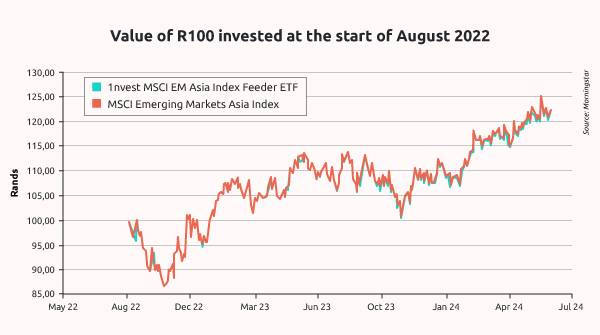
1nvest offers two broad types of ETF. First, we have funds that invest in shares, bonds and currency. For example, our 1nvest MSCI EM Asia Index Feeder ETF invests in Asian securities. These include Samsung, Tencent and Alibaba. Investors in this ETF don’t own these shares directly. Rather, you own a portion of the fund and thereby stand to benefit from growth in those shares in proportion to your ownership of the ETF.
Charting the performance of the 1nvest MSCI EM Asia Index Feeder ETF and the index that it tracks, the MSCI Emerging Markets Asia Index, shows just how effectively the ETF mimics the underlying index. The two lines separate only to a small extent, and for brief spells.
A second type of ETF holds commodities. These operate slightly differently as they don’t invest in companies. Instead, they own the actual metals that are physically stored in secured custodian vaults. For example, our 1nvest Gold ETF has recourse to gold bars. These are segregated, individually identified, and allocated alongside gold owned by other funds and even sovereign states.
Unfortunately, this doesn’t give you, as the ETF owner, the right to knock on the door and ask for physical gold in proportion to your ETF holding. However, holding the ETF is more convenient than that – and a lot safer.
As with all ETFs, you can buy and sell your share of the fund at any time while markets are open. Your share is a function of the value of the commodity held in the product.
Owning unit trusts
Unit trusts have important similarities with ETFs. They are also highly efficient tools for investors to participate in a diversified portfolio of underlying assets, without the time and cost it would take to go out and buy each of those individually. As the name suggests, when you invest in a unit trust, you own one or more units of the investment product, giving you a proportionate claim on the assets it holds.
The main difference is that unit trusts don’t trade on a stock exchange. This means you can’t log in at any time during the business day and see precisely what your share of the unit trust is valued at. Rather, prices are quoted once a day. As with ETFs, the price of the unit trust will track very closely with the prices of the assets it holds.
This all speaks to one of the primary benefits of the 1nvest product range: efficiency. Holding one of our ETFs or unit trusts brings the benefits of a diversified portfolio into a single, simple product.
View our full array of ETFs and unit trusts: https://1nvest.co.za/products/.
Collective Investment Schemes (CIS) are generally medium- to long-term investments. The value of participatory interests may go down as well as up. Past performance is not necessarily a guide to future performance. CIS are traded at ruling prices and can engage in borrowing and scrip lending. A schedule of fees and maximum commissions is available on request from the manager. The manager does not provide any guarantee with respect to the capital or the return of a CIS portfolio. These portfolios are third-party-named incubator portfolios. The manager retains full legal responsibility for these portfolios.
1nvest Fund Managers (Pty) Ltd is an authorised financial services provider (FSP), FSP No. 49955, under the Financial Advisory and Intermediary Services Act (FAIS), Act No. 37 of 2002. The manager of the Schemes is STANLIB Collective Investments (RF) Pty Ltd and registered in terms of CISCA. For the basis and information on awards and rankings, please contact [email protected].