For many South Africans, global investing has traditionally meant looking west – to New York, London or Frankfurt. But the world is changing. Economic momentum is increasingly shifting eastwards, and investors who ignore Asia may be missing a significant part of the global growth story.
China, in particular, has become too influential to overlook – despite easing back from its breakneck economic growth. The country’s economic choices increasingly shape global trends, from technology to trade to inflation. In fact, the sheer scale of China’s economy means its policy priorities often ripple across financial markets worldwide – a reality that, according to Senior Economist at Stanlib Asset Management Ndi Netshitenzhe, “makes it impossible for investors to simply opt out of China because it feels unfamiliar or complex”. This is a country at the centre of global dynamics right now,” she goes on. “They have also just outlined their 15th five-year plan, covering 2026 to 2030, giving tremendous insights on their longer-term goals.”
For everyday investors, understanding China and its role in a rapidly shifting world can help ensure portfolios are positioned for the future rather than the past.
It’s true that China is no longer the breakneck-growth story it has been in recent years. Economic expansion is moderating as the country becomes wealthier and more developed. But this transition is typical of maturing economies.
Growth is expected to settle at a lower but more sustainable level. Forecasts from the International Monetary Fund, for example, suggest medium-term growth of between 4% and 5%, reflecting demographic changes and a shift towards consumer-driven activity. Even the lower end prediction of 4% would be a dream figure for most countries. The global average growth rate is a little over 3%.
This moderation should not be mistaken for decline. A more measured pace of expansion often comes with deeper financial markets and more stable investment opportunities – a point Netshitenzhe makes clearly when she notes that slower growth simply reflects economic maturity rather than weakness.
Netshitenzhe also warns against another common misconception about modern China. “Some people still assume that China is the global factory for low-cost output,” she says. “But this hasn’t been the case for several years. The days of pumping money into infrastructure and exporting low-cost, low-value-add consumer items are long gone.”
The country is deliberately shifting away from infrastructure-heavy growth and low-cost exports. Instead, policymakers are aiming to position China as a leader in advanced industries such as artificial intelligence, green energy and high-tech manufacturing.
This strategic push to move “up the value chain”, according to Netshitenzhe, reflects a desire to compete directly with developed economies rather than rely on low-margin exports. “Just look at what China sells these days,” she continues. “Some of the best electric vehicles, cutting-edge AI, consumer electronics and the like are coming out of China. Yes, they can still do high volume and low cost. But they do so much more than that.”
For investors, this shows that exposure to China increasingly means exposure to technology, services and consumer demand – not just the China growth story and low-cost exports to the world.
In a globally connected world, focusing on one country alone would mean missing large parts of the phenomenon. “China’s evolution is also creating space for other countries in the region,” explains Netshitenzhe. “Beijing, Shenzhen and Shanghai may have led the way and received most of the headlines, but this is a regional story too. As global supply chains diversify, manufacturing has transformed economies such as Vietnam, Malaysia and India.”
These nations are well placed to absorb some of the industrial activity China is moving away from. Trade data confirms the shift. Vietnamese exports, for example, have increased sharply as companies diversify sourcing. “In fact,” says Netshitenzhe, “Reuters just reported that Vietnam recorded the world’s largest trade surplus with the US in January 2026.”

Source: Growth Lab at Harvard University
Despite Asia’s growing importance, many South African investors still allocate relatively little to the region. One reason is perception. Asian markets can feel distant, opaque or difficult to understand.
Yet this hesitation may create opportunity. The region’s complexity means investors sometimes need to work harder to uncover potential, but, as Netshitenzhe puts it, the rewards can be significant for those willing to “dig a little deeper” to understand what is happening.
China’s influence is already visible in everyday economic realities. In recent years, low-priced Chinese exports have helped keep inflation contained in many countries, including South Africa. Netshitenzhe notes that this dynamic has effectively allowed the world to “import low inflation” from China – a trend that could reverse as the country moves into higher-value production.
Perhaps the most useful takeaway for everyday investors is not about specific countries or sectors, but about mindset. News headlines about trade tensions, politics or market volatility can feel urgent. Yet structural economic shifts unfold over decades.
China’s policymakers are increasingly focused on strengthening domestic demand and building a more sustainable growth model – a strategic horizon that stretches far beyond short-term market noise. According to Netshitenzhe, this long-term planning is precisely why investors should focus on enduring trends rather than reacting to each new shock, including narratives about slower Chinese growth.
For South Africans investing with index funds, the message is clear:
As the global investment map continues to change, looking east may feel unfamiliar. But understanding the region, even at a high level, can help ensure that your savings benefit from some of the most important economic developments of our time.
The easiest way to start or grow your Asian investments is with the 1nvest MSCI EM Asia Index Feeder ETF. This broad emerging-Asia index fund provides low-cost, transparent access to this regional transformation without the need to pick individual winners.
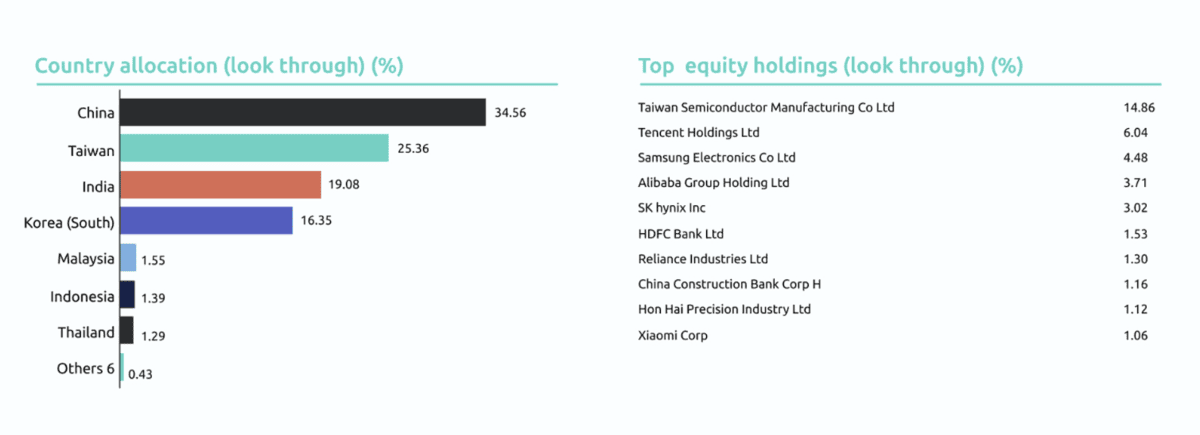
Just over one-third of the assets in this product are Chinese equities – think Alibaba, Tencent and China Construction Bank. The 25% Taiwan exposure gives you access to the booming semiconductor industry on the hyper-productive island. The nearly 20% allocated to India means a foot in the door of the world’s most populous country – now at nearly 1.5 billion people. And the substantial South Korean component includes world-leading consumer technology companies like Samsung.
Read all about the 1nvest MSCI EM Asia Index Feeder ETF here.
Collective Investment Schemes (CIS) are generally medium- to long-term investments. The value of participatory interests may go down as well as up. Past performance is not necessarily a guide to future performance. CIS are traded at ruling prices and can engage in borrowing and scrip lending. A schedule of fees and maximum commissions is available on request from the manager. The manager does not provide any guarantee with respect to the capital or the return of a CIS portfolio. These portfolios are third-party-named incubator portfolios. The manager retains full legal responsibility for these portfolios.
1nvest Fund Managers (Pty) Ltd is an authorised financial services provider (FSP), FSP No. 49955, under the Financial Advisory and Intermediary Services Act (FAIS), Act No. 37 of 2002. The manager of the Schemes is STANLIB Collective Investments (RF) Pty Ltd and registered in terms of CISCA. For the basis and information on awards and rankings, please contact [email protected].