Control what you can
In the world of finance, we go about maximising the return-risk ratio by identifying two basic types of risk: one that we can’t manage and one that we can.
Systematic risk is beyond our control. It refers to things like macroeconomic downturns, climate change, currency fluctuations and even geopolitical tensions. We can position our portfolios to deal with these as best we can. But these are inherent risks that impact entire markets in the same way.
Unsystematic risk is different. This happens at a company and industry level. Examples include management crises, product recalls and production shut-downs. These are challenges that can strike any company, but are unrelated to the broader market.
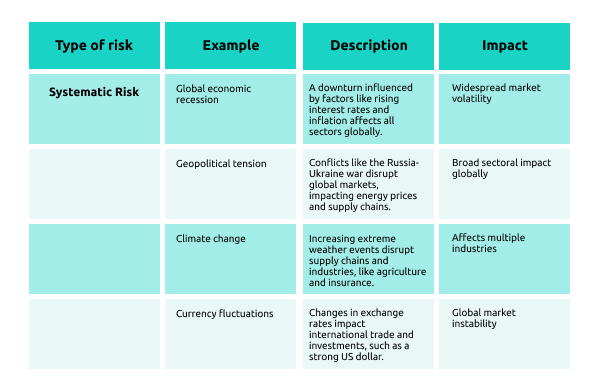
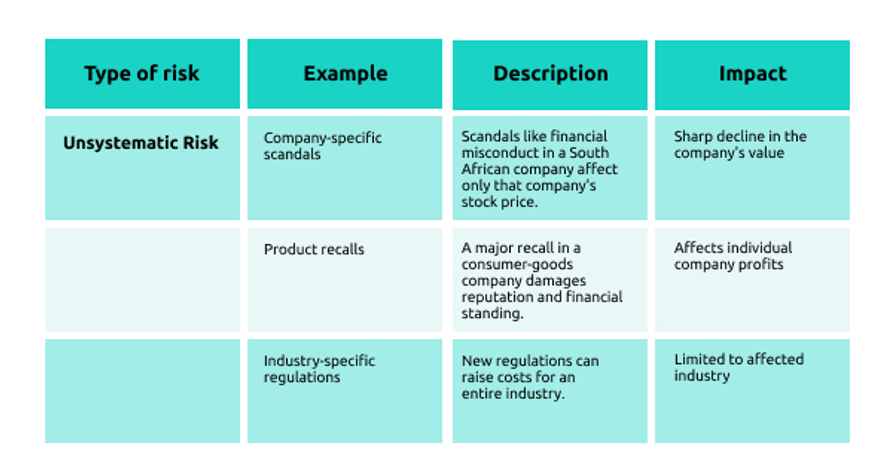
|
Type of risk |
Example |
Description |
Impact |
|
Systematic risk |
Global economic recession |
A downturn influenced by factors like rising interest rates and inflation affects all sectors globally. |
Widespread market volatility |
|
Geopolitical tension |
Conflicts like the Russia-Ukraine war disrupt global markets, impacting energy prices and supply chains. |
Broad sectoral impact globally |
|
|
Climate change |
Increasing extreme weather events disrupt supply chains and industries, like agriculture and insurance. |
Affects multiple industries |
|
|
Currency fluctuations |
Changes in exchange rates impact international trade and investments, such as a strong US dollar. |
Global market instability |
|
|
Unsystematic risk |
Company-specific scandals |
Scandals like financial misconduct in a South African company affect only that company’s stock price. |
Sharp decline in the company’s value |
|
Product recalls |
A major recall in a consumer-goods company damages reputation and financial standing. |
Affects individual company profits |
|
|
Industry-specific regulations |
New regulations can raise costs for an entire industry. |
Limited to affected industry |
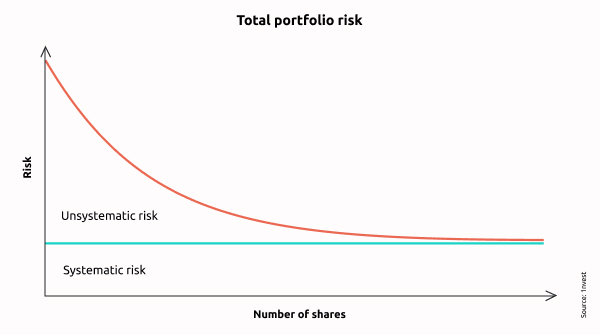
While we largely accept systematic risk as part of investing life, we have powerful tools at our disposal to limit unsystematic risk. The technical term is optimisation, using the Markowitz mean-variance framework. In essence, it means not putting all your eggs in one basket.
Investing in multiple companies means we aren’t taking any excess risk in the particular fortunes of any single business. For example, a corporate scandal can strike unexpectedly. Being heavily invested in that single affected business will have a major negative impact on your finances.
However, holding a variety of shares means you are exposed to the general risk that some scandal will strike somewhere at some time. But no single business can have an outsized effect on your portfolio when scandal hits.
Correlation is key
We can go further than that. By holding multiple asset types in different geographies across a multitude of industries, we can all but banish unsystematic risk. We do this by ensuring we hold assets that exhibit low correlation. This means the asset prices respond in different ways to the same market conditions.
Two assets are highly correlated if their prices rise and fall together. For example, two emerging market currencies may benefit from an unexpected rise in demand for commodities and fall when interest rates are hiked in the US. Holding these two currencies does little to mitigate our portfolio’s risk profile.
We improve our return-risk ratio when adding assets with low correlation to the mix. For example, a South African investor with local bonds can add US treasuries to his or her portfolio. This diversifies away some of the risk of being too heavily reliant on the South African government’s fiscal situation. The same applies to holding shares across different industries.
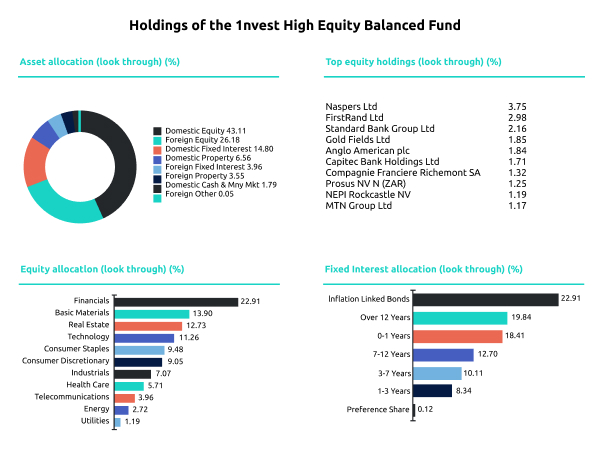
Our 1nvest High Equity Balanced Fund employs all of this thinking. It provides a carefully formulated mix of local and foreign assets, some of them equities and others bonds. It holds shares from a wide spectrum of industries and companies, and bonds with a variety of maturity dates.
The right tool for the task
None of this is to say that all risk can be eliminated. Far from it. Risk is like death and taxes – guaranteed.
The task is to ensure we aren’t taking any excess risks for a given expected return. 1nvest provides tools to help achieve this. Our exchange traded funds (ETFs) and unit trusts allow you to quickly and cost-effectively invest in bundles of shares and bonds from around the globe.
See how how our 1nvest High Equity Balanced Fund can help to optimise your portfolio to get rid of unnecessary risk: https://1nvest.co.za/wp-content/uploads/fund-factsheets/1nvest_High_Equity_Balanced_Fund_Comprehensive.pdf
Collective Investment Schemes (CIS) are generally medium- to long-term investments. The value of participatory interests may go down as well as up. Past performance is not necessarily a guide to future performance. CIS are traded at ruling prices and can engage in borrowing and scrip lending. A schedule of fees and maximum commissions is available on request from the manager. The manager does not provide any guarantee with respect to the capital or the return of a CIS portfolio. These portfolios are third-party-named incubator portfolios. The manager retains full legal responsibility for these portfolios.
1nvest Fund Managers (Pty) Ltd is an authorised financial services provider (FSP), FSP No. 49955, under the Financial Advisory and Intermediary Services Act (FAIS), Act No. 37 of 2002. The manager of the Schemes is STANLIB Collective Investments (RF) Pty Ltd and registered in terms of CISCA. For the basis and information on awards and rankings, please contact [email protected].