Recent returns on the Johannesburg Stock Exchange (JSE) are real-life evidence of this. The bourse underperformed for a spell. But throughout the tough times, many analysts argued that share prices were too low, and due for a so-called reversion to the mean – a rise to their appropriate values. The last year of excellent performance backed that up. The FTSE/JSE Africa All Share Index – an indicator of the broader JSE – is up more than 26% for the last 12 months.
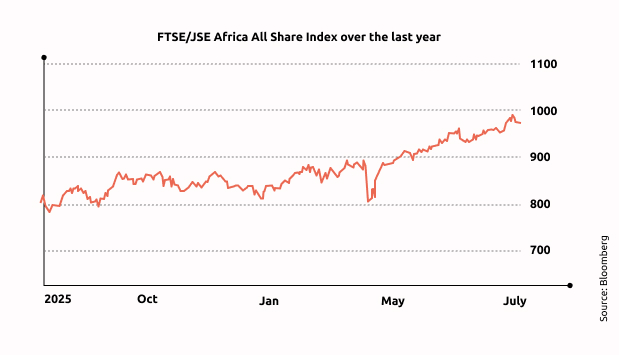
The important question: Why? While short-term volatility can be difficult – if not impossible – to explain, we can point to fundamentals to help understand large, longer-term trends. Several major ones have been key drivers of the JSE’s buoyancy of late.
Worth its wait
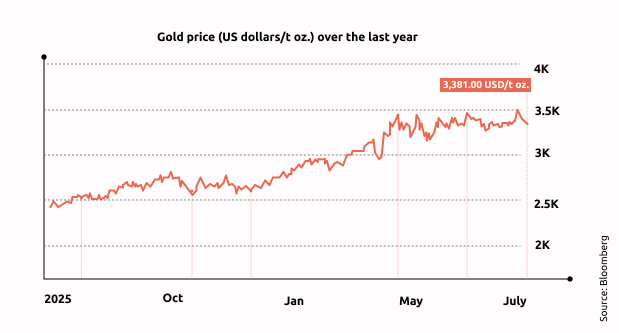
Perhaps the most newsworthy contributor has been the gold price. The metal makes up nearly 13% of South Africa’s exports. With global geopolitical volatility at all-time highs, many indicators of uncertainty are above COVID levels – gold’s status as a safe-haven investment has come to the fore.
Platinum has come to the party, too. While it arrived later than its yellow cousin, the metal’s price has also risen meaningfully. This important green-energy metal makes up 9% of South Africa’s exports. Furthermore, in Q2 2025, the platinum price rose 34% on forecasts of a sustained deficit, boosting sentiment towards PGM shares.
Even flawed GNUs are good news
The economy is often downstream from politics. We have experienced this since South Africa’s national election in May 2024 and the subsequent formation of a Government of National Unity (GNU).
The agreement between the long-governing ANC and challenger parties is far from perfect, and we have seen substantial disagreement. This was highlighted in February 2025 with the postponement of the presentation of the national budget as politicians jostled over VAT hikes. However, markets don’t need perfection from the government. Often, a fair and democratic election followed by a flawed but workable power-sharing arrangement is enough.
Emerging market momentum
South Africa is also benefiting from a ‘risk-on’ attitude towards emerging markets generally. With growth in much of Europe lagging, earnings positive, and African resources in demand, value in EMs is attractive.
South Africa has a unique position in this dynamic. Among its emerging market peers, South Africa boasts a large and highly developed financial sector. This makes the JSE a preferred means of accessing emerging market equities.
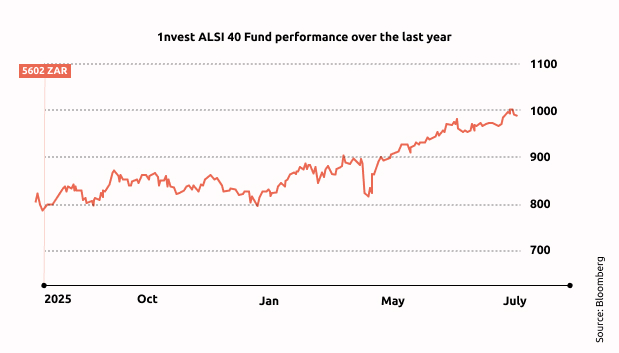
This positivity has filtered through to performance in several 1nvest products. Just one is the 1nvest ALSI 40 Fund. This unit trust has returned 26.17% over the last year.
Another tailwind for South Africa has been steady progress on the reforms needed to exit the so-called “grey list”. The Paris-based Financial Action Task Force (FATF) has placed South Africa on the list of countries that aren’t doing enough to deal with illicit movements of money. Having provided 22 deficiencies, local authorities have worked steadily to address each weakness.
Lesetja Kganyago, governor of the South African Reserve Bank, recently announced that all 22 issues had been successfully addressed. A likely removal from the list will be a welcome signal of stability to investors.
Beyond GDP
Finally, it’s worth noting an important distinction. It is no secret that South Africa’s GDP is struggling to grow. Most forecasts hover around 1% growth for the foreseeable future. One might ask, how is the JSE growing while the broader economy isn’t?
While GDP – a measure of all goods and services sold in a country over a year – is an important part of equity returns, it’s one of many factors. Shares are also driven by everything from corporate earnings and global megatrends to rand-dollar exchange rate variations and resource cycles.
1nvest offers you several products that benefit from the strong run of the JSE. The 1nvest ALSI 40 Fund is a unit trust that holds shares in the 40 largest businesses on the exchange. Read about the ways the 1nvest ALSI 40 Fund can contribute to your portfolio here.
#ETF #Equities #JSE #LongTermInvesting
Collective Investment Schemes (CIS) are generally medium- to long-term investments. The value of participatory interests may go down as well as up. Past performance is not necessarily a guide to future performance. CIS are traded at ruling prices and can engage in borrowing and scrip lending. A schedule of fees and maximum commissions is available on request from the manager. The manager does not provide any guarantee with respect to the capital or the return of a CIS portfolio. These portfolios are third-party-named incubator portfolios. The manager retains full legal responsibility for these portfolios.
1nvest Fund Managers (Pty) Ltd is an authorised financial services provider (FSP), FSP No. 49955, under the Financial Advisory and Intermediary Services Act (FAIS), Act No. 37 of 2002. The manager of the Schemes is STANLIB Collective Investments (RF) Pty Ltd and registered in terms of CISCA. For the basis and information on awards and rankings, please contact [email protected].