What is property?
The changes the world has undergone in the last five years have demanded that investors rethink property: what it is and what it means. Of course, property remains land and the structures built on it. But as an investment, technology, culture and lifestyle changes mean this asset is far more dynamic than before.
Consider the revolution led by Airbnb. Suddenly, we had to address the question: does a hotel company need to own any rooms? The answer has been shown to be no. A hotel company can own technology, and the bricks and mortar will come to it.
We’ve also had to reassess what it means to work in an office. Until 2019, we had a pretty good sense of this. We went to an office in the morning and came home at the end of the day. Now, we have hybrid work and “the office” could mean a coffee shop, a co-working space or even a beach lounger. That is, anywhere you can take your laptop.
Positive changes for property investors
One positive signal for property is the global and local trend in interest rates. The cycle of hiking rates appears to have done its job of limiting post-Covid inflation. Central banks are now showing increasing confidence to cut rates.
In recent announcements, the South African Reserve Bank and US Federal Reserve Bank lowered the rates at which they lend to banks. This is a push in the right direction for property markets.
WFH becomes RTO
Another trend is employees returning to the office. While hybrid and remote work seem likely to continue, many businesses want to have more of their people on site. In fact, the work from home (WFH) revolution is being countered by another initialism: RTO (return to office).
Big employers like Amazon are increasingly demanding that staff return to the office instead of working from home. This trend marks a stimulus for property and office rental prices.
How to share in this property boom
One of the quickest, easiest ways to get onto the property ladder is by investing in property funds. A diversified portfolio of shares in listed property companies offers exposure to all of the trends benefitting property. Our 1nvest SA Property ETF is just that.
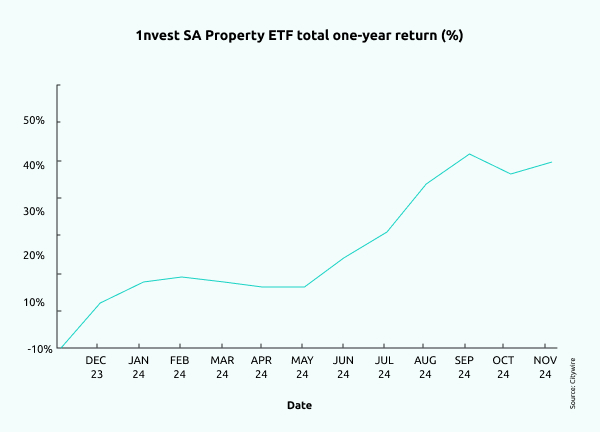
This ETF is an index of the top 20 property companies by market capitalisation that have a primary listing on the JSE. From industrial and retail to storage and accommodation, the 1nvest SA Property ETF provides the investor cost-effective, simple access to South Africa’s major property shares all in one product. Plus, investors in this fund enjoyed a return of 40% for the year to the end of November 2024.
Interested? Find out how to invest in 1nvest’s SA Property ETF here.
Collective Investment Schemes (CIS) are generally medium- to long-term investments. The value of participatory interests may go down as well as up. Past performance is not necessarily a guide to future performance. CIS are traded at ruling prices and can engage in borrowing and scrip lending. A schedule of fees and maximum commissions is available on request from the manager. The manager does not provide any guarantee with respect to the capital or the return of a CIS portfolio. These portfolios are third-party-named incubator portfolios. The manager retains full legal responsibility for these portfolios.
1nvest Fund Managers (Pty) Ltd is an authorised financial services provider (FSP), FSP No. 49955, under the Financial Advisory and Intermediary Services Act (FAIS), Act No. 37 of 2002. The manager of the Schemes is STANLIB Collective Investments (RF) Pty Ltd and registered in terms of CISCA. For the basis and information on awards and rankings, please contact [email protected].