This translates well into macroeconomics. Much of the monumental rise in prosperity the world has seen in recent decades is the result of specialisation and trade. Blessed with mineral resources, South Africa can produce an ounce of gold far more efficiently than most countries. It makes sense for us to become exceptionally good at this and to sell on the global market. Contrast that with Taiwan. Lacking space and deposits, the small Asian island couldn’t hope to flourish on mining. So they stick to their knitting. They produce computer processors better than anyone else and sell them to every corner of the world. And the list goes on.
In short, when we specialise and trade, we all benefit. The question is, how can investors benefit from this? In particular, how can South Africans use this knowledge to build smart portfolios in the face of local economic headwinds?
Perhaps the most powerful tool we have for such “financial emigration”, as it’s popularly known, is the exchange traded fund (ETF). An ETF can be listed and traded on the Johannesburg Stock Exchange (JSE) and enable us to invest in an array of assets, across geographies and industries. Designed properly, it can do this with extraordinary efficiency.
Globalise and gain
An ETF listed in South Africa is bought and traded in rands. However, holding this asset can give local investors exposure to an almost unlimited array of equities and bonds around the world. Whether it’s shares in a basket of government bonds or shares in blue-chip Asian corporates, there’s a product that does the job.
Whether it’s the Taiwanese knack for tech or German engineering you want in your portfolio, there’s an ETF for that.
The diversification benefits go beyond the geographic. An intelligently constructed portfolio will also be able to utilise ETFs to diversify across market cycles. This gives financial planners powerful capabilities to craft a client’s risk-return position.
It is also tax efficient. You can invest via your tax-free savings account. That means avoiding paying capital gains, dividend withholdings or income tax within specified limits. Additionally, certain types of investors need not utilise their offshore allowances.
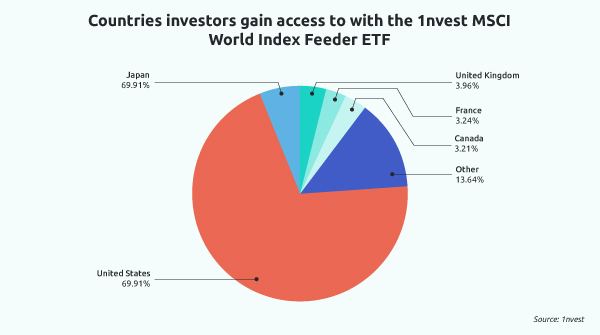
All of the general benefits of ETFs apply, too. You can try individually purchasing shares in 1 480 companies around the world in the relevant currencies, or you can get access to all 1 480 by holding the 1nvest MSCI World Index Feeder ETF.
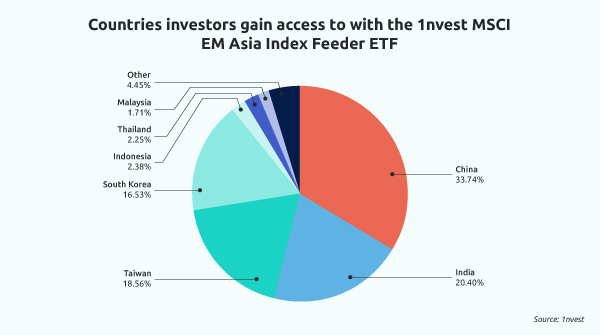
Fancy something slightly more targeted? You can use an ETF to “buy emerging Asia”. The 1nvest MSCI EM Asia Index Feeder ETF gives a portfolio exposure to the performance of large- and mid-cap stocks in 8 select Asian emerging countries. This is a good option to participate in the burgeoning sectors of information technology, financials and consumer discretionary.
If you’re interested in financially emigrating with the simplicity and power of ETFs, view our full range of these products here: 1nvest Products – 1nvest Exchange Traded Funds.
Collective Investment Schemes (CIS) are generally medium- to long-term investments. The value of participatory interests may go down as well as up. Past performance is not necessarily a guide to future performance. CIS are traded at ruling prices and can engage in borrowing and scrip lending. A schedule of fees and maximum commissions is available on request from the manager. The manager does not provide any guarantee with respect to the capital or the return of a CIS portfolio. These portfolios are third-party-named incubator portfolios. The manager retains full legal responsibility for these portfolios.
1nvest Fund Managers (Pty) Ltd is an authorised financial services provider (FSP), FSP No. 49955, under the Financial Advisory and Intermediary Services Act (FAIS), Act No. 37 of 2002. The manager of the Schemes is STANLIB Collective Investments (RF) Pty Ltd and registered in terms of CISCA. For the basis and information on awards and rankings, please contact [email protected].