Considering that investor anxiety is at a five-year high, the question is: what should you do?
We know that panic is not a strategy, even if topsy-turvy environments make it tempting to cut and run. As we frequently say, time in the market beats timing the market. This principle makes cutting and running a costly approach, often leading to losses. Even the smartest investors are prone to selling low and buying high when trying to outsmart the collective wisdom of markets.
This is where planning comes in. A sound financial plan is built to give you the tools and confidence to ride out the inevitable tough times and benefit maximally from good times. In other words, your portfolio should have some cushion.
So, how do you ensure your investments have some cushion against shocks? There are two basic requirements.
Low correlation, high cushion
First, hold a variety of assets. Second, ensure those assets respond differently to market conditions – in the jargon, assets should exhibit low correlation.
Together, these two features provide cushioning for your portfolio. Sure, your rand-based assets will have down periods. But that’s why you have dollar-based ones as well. South African bonds are similarly weakly correlated with American bonds. Likewise, property responds to market forces differently than tech stocks. Some assets are winners in growth environments, while others are better at generating reliable income.
There are many examples of this growth-income relationship. The archetypical one is between company shares and government bonds. Shares tend to perform well during spells of economic expansion. However, we all know that share prices are sensitive to various factors, ranging from company performance to policy changes.
Bonds are different. Investors find them more stable than shares. For one thing, they aren’t reliant on companies meeting financial expectations. Instead, the issuing government pays a set coupon at set intervals. That doesn’t mean the risk is zero. Governments can default. But it is far less common than it is with companies, and analysts usually monitor country risk closely so we know when a default is looming.
Regardless of the assets in question, the fundamental principle remains: the lower the correlation due to broad diversification, the greater the cushion.
How balanced funds cushion investors in times of market volatility
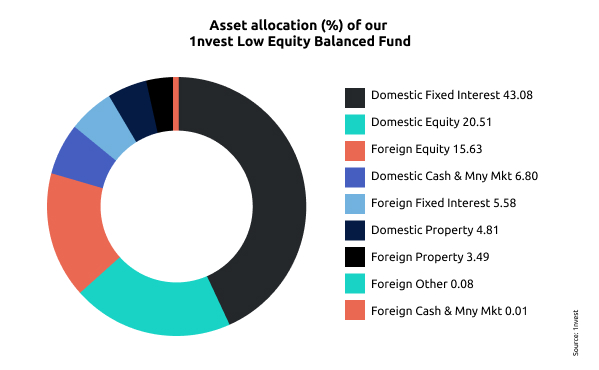
Balanced funds incorporate a purposefully chosen bundle of assets into a single product to achieve a specific objective. Different asset types from different regions ensure low correlation, which provides a cushion for volatile times.
Source: 1nvest
Our 1nvest Low Equity Balanced Fund is an example that is particularly relevant to current conditions. Although it contains equities, this is not an aggressive fund and its risk rating is moderate. It aims to balance a relatively low proportion of local and international equities with local and international bonds, as well as exposure to property.
In other words, the fund provides investors with exposure to growth assets (equity) as well as with lower risk assets (bonds). This balance of growth and risk assets suits investors targeting a reasonable income from their investments combined with some capital growth over the longer term.
All of this is wrapped up in a single, cost-effective unit trust with fixed proportions of the various asset types. Our fund managers rebalance the fund every quarter based on changes in the value of the various assets. In this way, the fund’s strategic long-term asset allocation is maintained.
Find out more about the 1nvest Low Equity Balanced Fund and the balance of assets it contains or ask your financial advisor about incorporating it into your portfolio.
Collective Investment Schemes (CIS) are generally medium- to long-term investments. The value of participatory interests may go down as well as up. Past performance is not necessarily a guide to future performance. CIS are traded at ruling prices and can engage in borrowing and scrip lending. A schedule of fees and maximum commissions is available on request from the manager. The manager does not provide any guarantee with respect to the capital or the return of a CIS portfolio. These portfolios are third-party-named incubator portfolios. The manager retains full legal responsibility for these portfolios.
1nvest Fund Managers (Pty) Ltd is an authorised financial services provider (FSP), FSP No. 49955, under the Financial Advisory and Intermediary Services Act (FAIS), Act No. 37 of 2002. The manager of the Schemes is STANLIB Collective Investments (RF) Pty Ltd and registered in terms of CISCA. For the basis and information on awards and rankings, please contact [email protected].