Markets took this as a threat to the near monopoly of chip designer Nvidia, whose share price plummeted more in one day than any share has done in history. However, the real takeout is a far broader one – that competition in the tech industry is playing out at continental level, and that it’s a good thing.
The two super innovators, China and the US, in particular, are battling it out in the tech sector. From design to manufacturing, big data to e-commerce, these giants are pushing each other to new heights.
Asia vs America
The US market generally dominates technology and the emerging megatrend of artificial intelligence (AI). The seven biggest US tech companies – Alphabet, Amazon, Apple, Meta, Microsoft, Nvidia, and Tesla – are 20 times larger than the EU’s seven largest, and generate more than ten times more revenue. These US-based household names and more are all included in the award-winning 1nvest S&P500 Info Tech Index Feeder ETF.
However, Asia is not far behind, accounting for about a quarter of the worldwide AI market. Moreover, Asia is the region set to gain the most from AI in the years to come. A 2023 PWC study estimated that China will reap a 26% boost to their GDP in 2030 from AI compared to a forecasted 14% boost for North America.
Asia’s AI ecosystem
Asia’s tech sector has several standout characteristics. E-commerce is large and growing. Think of companies like Alibaba and Tencent. Temu is the latest name to rocket into our lives.
Asia is also the world’s AI manufacturing hub. China, Taiwan and South Korea are powerhouses in the production of the chips that are enabling the AI revolution. Taiwan Semiconductor Manufacturing Company (TSMC) stands out as the chief fabricator of Nvidia chips. China’s Foxconn famously does much of the manufacturing of iPhones.
Several governments in Asia are noteworthy for their support of tech. China and Singapore are champions in this regard. They invest heavily in AI, quantum computing, and biotech. This, coupled with regulation, is an important enabler of a thriving AI industry as we grapple with this novel technology.
Investing in Asia’s booming tech businesses
Our 1nvest MSCI EM Asia Index Feeder ETF is designed to provide efficient, simple access to the top tech stocks in emerging Asia. In fact, this ETF holds more than 1 000 stocks across various tech sub-sectors in 14 countries.
These five leading tech companies from Asia make up the five biggest holdings in our 1nvest MSCI EM ASIA Index Feeder ETF.
Tencent offers a very different angle into Asia’s tech scene. The business offers a diverse range of services, including social networking, gaming, cloud computing, fintech, and online advertising. Tencent operates WeChat (known as Weixin in China), the country’s largest social-media super app, and is recognised as the world’s largest video game publisher, owning popular titles like Honor of Kings.
The group has been vocal about using AI to leverage dominance in e-commerce and cloud computing, and injecting efficiencies into its business.
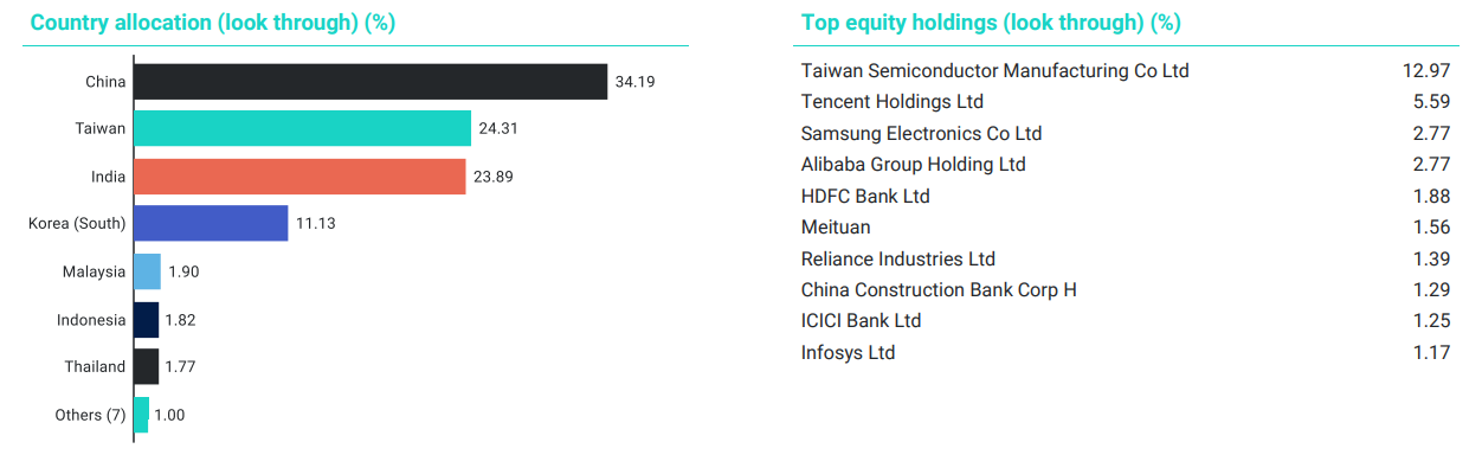
Source: 1nvest
All together now
When Asia’s DeepSeek and America’s Nvidia clashed in January, markets got nervous. Less than two months later, the battered Nvidia stock price is making a comeback.
When competitors collide, a short-term shock is not surprising. In the long term, vigorous competition can be a good thing. The best minds in the world tend to push one another to new heights. That means better products – and investments – for us all.
Fortunately for investors, it is not an either/or decision. Our 1nvest MSCI EM Asia Index Feeder ETF is a highly effective, easy way to gain access to Asia’s growing tech phenomenon. While the US looks set to dominate Big Tech and AI, there is plenty to gain from expanding a portfolio to gain from the diversity and growth of Asia’s emerging tech giants.
Collective Investment Schemes (CIS) are generally medium- to long-term investments. The value of participatory interests may go down as well as up. Past performance is not necessarily a guide to future performance. CIS are traded at ruling prices and can engage in borrowing and scrip lending. A schedule of fees and maximum commissions is available on request from the manager. The manager does not provide any guarantee with respect to the capital or the return of a CIS portfolio. These portfolios are third-party-named incubator portfolios. The manager retains full legal responsibility for these portfolios.
1nvest Fund Managers (Pty) Ltd is an authorised financial services provider (FSP), FSP No. 49955, under the Financial Advisory and Intermediary Services Act (FAIS), Act No. 37 of 2002. The manager of the Schemes is STANLIB Collective Investments (RF) Pty Ltd and registered in terms of CISCA. For the basis and information on awards and rankings, please contact [email protected].